

This November, Florida voters will decide on Amendment 3, a constitutional amendment that would raise the homestead exemption on non-school property taxes from $50,000 today to $150,000 in 2027 and $250,000 in 2028. The change would significantly reduce the revenue available to local governments. Statewide, non-school property tax collections would shrink by roughly 20–23%, an estimated $8.7 billion a year by 2029, rising to nearly $11.8 billion by 2032. Amendment 3 would lower annual property taxes from around $1,000 - $3,000 for homeowners, depending on the jurisdiction.
If passed, Amendment 3 gives local governments three choices: 1) reduce spending; 2) raise property tax rates on the remaining tax base; or 3) raise other taxes and fees.
Local governments are likely to rely on a mix of all three, but to the extent they respond by raising property tax rates to offset revenue losses, rental housing could pay more.
Analyzing the Potential Impacts on Rental Housing
Jared Walczak, a national property tax expert with Walczak Policy Consulting, conducted a statewide analysis examining how Amendment 3 could affect property taxes on rental homes across Florida. The analysis puts a dollar figure on how much rents could rise if Amendment 3 passes and local governments raise property tax rates to make up for the lost revenue. The full report, including a county-by-county breakdown, is available here.
This analysis solely looks at what could happen to rental housing costs if local governments cover the full loss by raising property tax rates alone. The analysis doesn’t aim to show how much rents will definitively rise in each county, but it does show one potential path that Amendment 3 could lead to. In practice, local governments will likely cut spending and/or raise fees instead or in addition to raising millage rates, and the mix will differ by jurisdiction.
Here are the main takeaways I gathered from Walczak’s analysis:
Amendment 3 lowers property taxes for homeowners and could shift the cost to renters. If local governments raise property tax rates to cover revenue losses under Amendment 3, the average Florida apartment unit’s annual property tax bill could go up $406 (14.8%) in 2028, and $554 (15.75%) by 2031. For a typical 200-unit apartment community, that’s about $81,000 more in property taxes each year in 2028, rising to about $109,000 by 2031.
Renters of single-family homes could be hit harder: an average $1,081 (14.6%) increase in 2028, rising to $1,471 (15.4%) by 2031. About one in four of Florida’s renters live in a single-family home.
Renters would likely end up paying most of this through higher rent. Research on past tax increases show landlords typically pass at least 60% of the cost on to tenants, and often nearly all of it over time. A $400 tax increase on an apartment could mean about $240 more in rent per year; for a Tampa single-family rental, about $780 more. Effects on rents will vary by market.
Statewide, that could be up to $1.61 billion in added property taxes on rental homes in 2028, growing to $2.19 billion by 2031.
The impacts would vary by local government. In Tampa, average yearly property taxes could rise $758 per apartment and $1,329 per single-family rental in 2028. Other areas could see increases as well: Miami-Dade (+$291 per apartment), Orlando (+$358), Fort Lauderdale (+$504), and Pinellas (+$549).
Impacts to affordable housing. Many income- and rent-restricted rental homes don’t qualify for property tax exemptions, so owners often can’t pass cost increases on to residents — which can limit their ability to make repairs and capital improvements. Most of Florida’s affordable rental homes aren’t part of a formal affordable housing program at all; they’re just naturally lower-priced, and those could see rent increases as well.
New home and apartment building could slow as local governments respond differently and on different timelines, creating uncertainty for builders about future tax rates, fees, and services.
The impact varies by location. Here are the breakdowns for counties and select municipalities. For an interactive map, see here. With this map, you can select your county and see the possible increases to property taxes on apartments and single-family rentals.
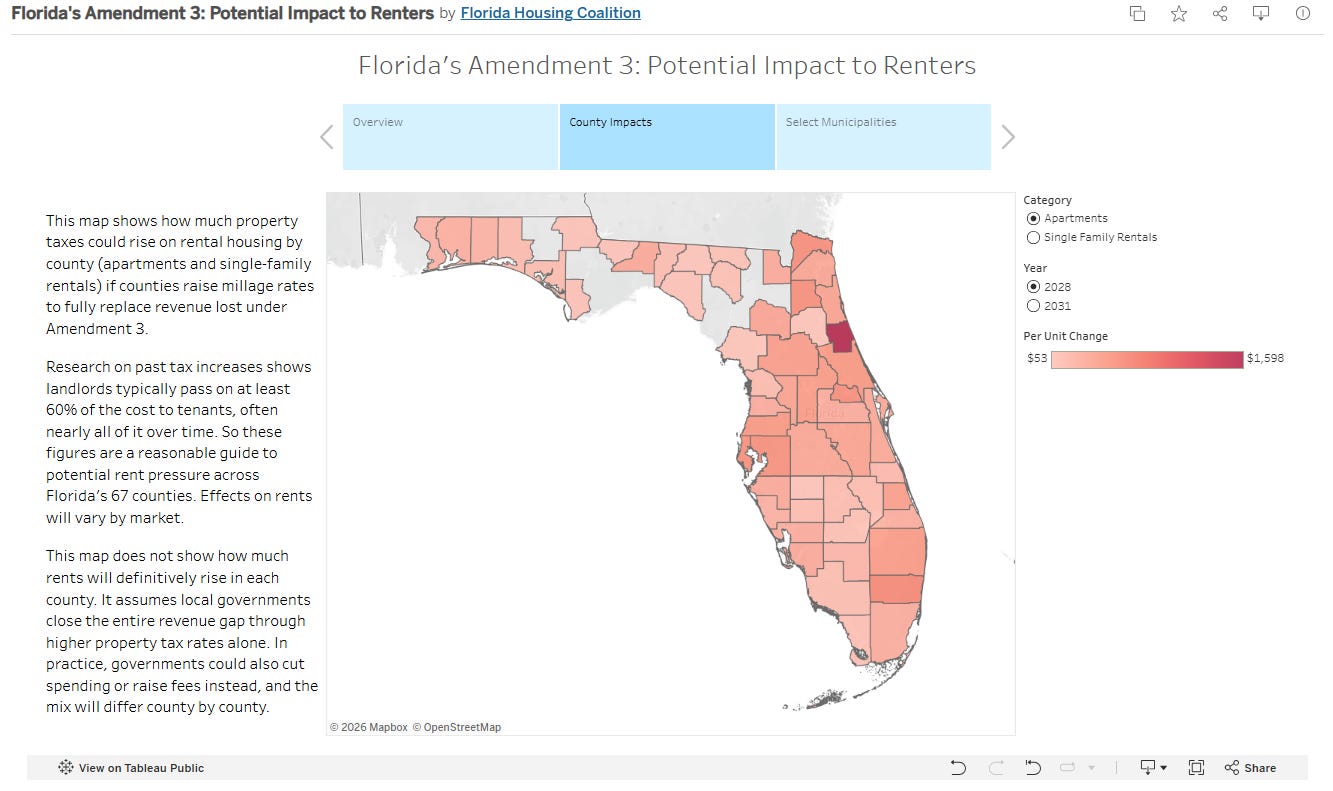
County-by-County Breakdown + Select Cities
Below are two tables that show Walczak’s findings for how much property taxes could increase on apartments and single-family rentals if the county increases millage rates to fully offset revenue losses under Amendment 3.
Renters May Bear Much of the Cost
Tenants don’t pay property tax bills directly, but they bear most of the burden through higher rents. Most analyses find renters absorb at least 60% of the cost of property taxes on rental housing — a share that can approach 100% over time. The pass-through won’t be instant, but renters have reason to expect they’ll ultimately shoulder most of any tax shift onto rental property.
This means that an annual $400 property tax increase on an apartment could mean at least $240 more in annual rent. For a single-family rental in Tampa, that’s at least $780 more a year.
Where rents can’t absorb the full increase, the consequences could show up elsewhere: reduced capacity for repairs, deferred maintenance, and less attractive returns for building new rental housing, constraining supply and making the remaining stock less affordable.
The impact could be especially acute for affordable housing, both subsidized and naturally occurring. Owners of income-restricted units without an affordable housing property tax exemption often can’t pass the full increase through, limiting their ability to maintain units and make capital improvements. This also could discourage new construction, since higher, growing tax liability cuts into expected returns with no corresponding ability to raise rents. The naturally occurring affordable housing supply, which makes up most of Florida’s affordable housing stock and generally doesn’t qualify for an affordable housing property tax exemption, could also raise rents under Amendment 3.
Uncertainty for Affordable Housing Builders
If Amendment 3 is adopted, new development could slow, at least initially, given uncertainty about the prospects of tax shifts in each jurisdiction. Local governments likely won’t decide how to respond overnight, and until they do, builders are left guessing which jurisdictions will raise property tax rates, hike fees, or cut the services that support a project’s long-term value.
That uncertainty flows directly into the numbers that make or break a new affordable housing community. Affordable housing developments are typically underwritten years in advance, with tight margins and financing structures that depend on predictable operating costs over a lengthy compliance period. A project that pencils out today could fall apart if a lender or investor prices in the risk of a future millage increase, or if a jurisdiction’s tax shift arrives mid-construction and blows through a project’s contingency budget.
Lenders and equity investors may respond to that uncertainty with more conservative underwriting, which can shrink the amount of debt or equity a project can raise. This means fewer units, longer timelines, or projects that don’t get built at all. Local governments facing their own revenue uncertainty may also be less inclined to offer local funding, public land, density bonuses, and expedited permitting, tools affordable builders may rely on to make projects viable.
The Bottom Line
Amendment 3 would lower annual property taxes from around $1,000 - $3,000 for homeowners, depending on the jurisdiction. But if local governments respond by raising millage rates to stay revenue-neutral, much of that cost could shift onto renters and rental housing owners — at a time when more than 1.7 million renter households in Florida are already rent-burdened, spending over 30% of their income on housing.
This analysis was commissioned in partnership with the Florida Housing Coalition, Florida Apartment Association, Miami Homes for All, and the Florida Policy Project.